
Tuesday, June 29, 2010
Max's Kansas City
Our story about the film Ultra Violet for 16 Minutes was featured over at Max's Kansas City. Check it out! http://www.maxskansascity.com/blog/

Wednesday, June 23, 2010
Cats and Dogs and William Wegman

Many of you have probably seen the adorable video of a group of kittens "dancing" (or turning their tiny adorable heads in tandem) all over the internet the last few weeks and pictured above at left. But what you may not have realized in watching this video, and those like it which have circulated before, is that the idea ripped from a 1975-1976 art film by William Wegman entitled Dog Duet (pictured above at left). Wegman's secret to getting the dogs to eerily look wherever he wanted? Hold a tennis ball off-screen and move it around.
You might know Wegman from his appearances with his trusty Weimaraner dogs on Sesame Street, the Tonight Show, Saturday Night Live, or maybe from his recent and wildly successful edition of photos and prints with Jen Bekman's 20x200.
Watch the fun and adorable "Technokittens" video HERE
Watch the fun but haunting Wegman video HERE
Saturday, June 5, 2010
Ultra Violets are Blue

"...The dog was not on drugs, and the cat was not on drugs, and I was not on drugs." -Factory Superstar Ultra Violet on Warhol's Factory
The tragic demises of factory girls Edie Sedgwick and Nico make it initially hard to believe fellow Warhol Superstar Ultra Violet's claim that she remained relatively sober through those wild Warholian years. But seeing her up close and sharp as a tack at 74 in David Henry Gerson's new short film Ultra Violet for Sixteen Minutes reveals she really may have been as clean as the cat.
Mr. Gerson met Ultra (legally Isabelle Collin Dufresne), still a fixture at gallery openings in New York City and usually recognizable in her signature purple garb, several years ago. At her urging, they decided to embark on documentary about her extraordinary life, starting as child in France excommunicated from the Catholic church who found her way to the United States as a young woman. Once in the states, Isabelle became first assistant and then mistress to Salador Dali who would introduce her to Warhol. She took her place as a “Warhol Superstar” for several years, then later went on to become Ed Ruscha’s mistress. After years of artworld debauchery, Ultra left Ruscha and found God, and has since become an active member of The Church of Latter-Day Saints and an artist in her own right.
The film has deep religious themes and explores Ultra's role as a serial disciple-- of Dali, of Warhol, of fame, and of God. I spoke to filmmaker David Gerson and he described her disciple-ship as linking the contemporary fame/celebrity conversation to a 5000 year old history, which seems like a nice way connect it all. Art, fame, genius, celebrity, religion--there are some things so seductive and beautiful that they just cannot be denied. Yet Ultra Violet is as much the seducer as she is the seduced; you only have to look at her photo (above), list the great men she's captivated, and listen to her engaging life story to realize as much.
Check out the film’s review over at the Huffington Post, and see David Henry Gerson's Ultraviolet for Sixteen Minutes June 18th at the New Jersey International Film Festival. For additional show dates and information about the film, visit its website.
Tuesday, May 18, 2010
May Flowers
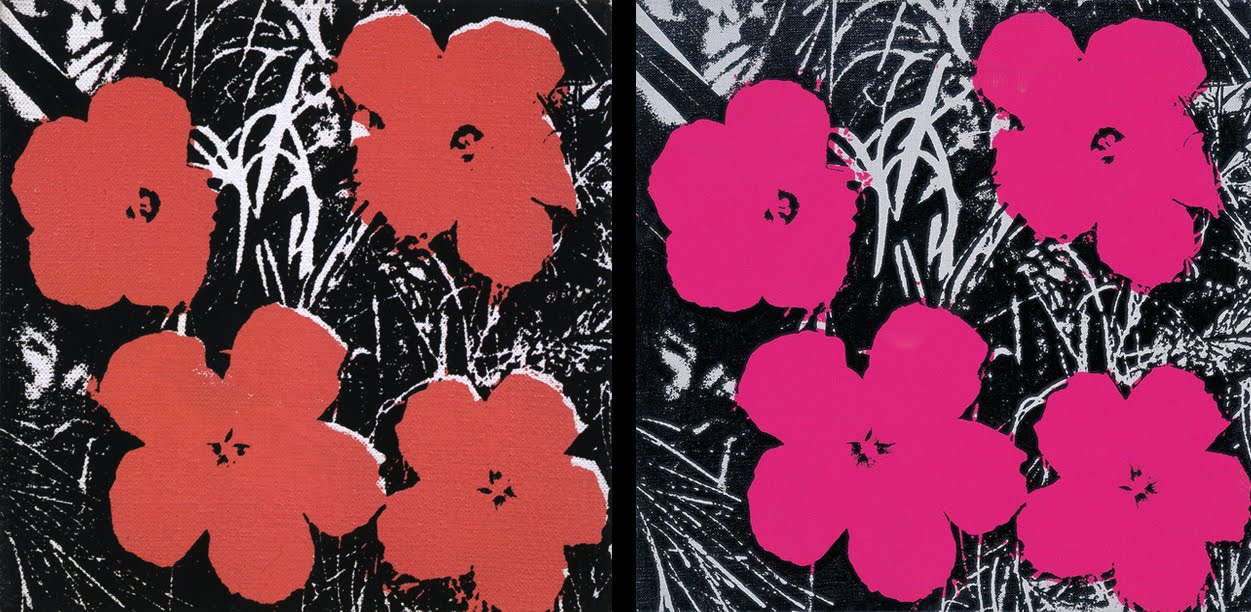 A while back, I wrote about how photography is the new painting. It was probably something you should read about here. Anyway, today, I was again reminded of how much our digital (and analog) devices warp the world around us while at my trusty gallery day job. I was looking for information about the work above to the right, the hot pink Warhol flowers. After doing a little research on the piece, I discovered it actually looked like the picture on the left, more of an orangey-coral than a fuchsia. When a work relies on one single specific color to differentiate itself from hundreds of other, it seems like good, true to life artwork photography would be a priority for those dealing with the piece. But good artwork photography is hard to get and digital images degrade over time (just like paintings) so distortion continues to be a problem.
I'm still backed up here at F***ART, and have yet to post about the May auctions or my recent viewing of the short film 16 Minutes with Ultra Violet, but stay tuned for more posts soon, I promise!
Also, a side note: what species are Warhol's "flowers"? He obviously chose the image as quintessentially floral, but no amount of googling seems to yeild me with an answer as to what this most-floral of flowers is. (The fact that it's a pretty blown-out image doesn't help my search either)
Tuesday, April 20, 2010
Baby, Hold on to Me
 An interesting article in the New York Times today got me thinking about the rules of art auctions and how they can be a double-edged sword.
The article (which you can read HERE) talks about how collectors (in particular, Craig Robbins, pictured above) who resell artwork they've bought on the primary market (or directly from the artist's representative) on the secondary market (or resale galleries/auctions) can be blacklisted for doing so too soon or even at all.
What's interesting is the way that strict unwritten (or according to the Times, written) rules govern the way collectors are allowed to buy and sell artwork if they want to stay in with the in crowd. It's a terrible faux-pas to resell art too soon after purchasing; it makes the work seem like a financial gamble instead of a masterpiece. It's even less couth to resell a work of art within a few years of being at auction, because, particularly with the growth of sites like artnet.com, the auction record is available publicly and everyone knows on exactly what day the work sold for and for how much--down to the penny.
But the granddaddy of all scarlet letters for artwork is the "BI" (short for Bought-In, or not sold at auction). For the rest of the artwork's life, no matter how lovely and well-priced, the work will always struggle because of its unshakable mark of BI-ness. It doesn't matter why the work BI'ed--there could have been, say, a volcano, that blocked all flights to the auction, or maybe just no good buyers for a very good work with a fair value--people don't want art that has BI'ed
When you think about all the risks involved, it's easy to wonder, why the hell would anyone ever auction off anything? The flip-side of the auction coin is that it can be a great way to raise some quick cash and/or to deaccession works that you just don't have time to deal with. And the there's always the promise of a jackpot--the Picasso or the Doig or the Giacometti that suddenly sells for far beyond the high estimate not only making you rich, but also changing the whole game.
Friday, March 26, 2010
Shear Loveliness
 Francois-Xavier Lalanne's sheep, both fluffy and stone, seem to keep popping up in my life and they are so stinking cute I can't handle it. They're apparently impossible to get your hands on, and it's just kind of funny that such a cute and silly decorative sculpture is so trendy. But I still have to sheepishly admit that I adore these little guys.
Tuesday, March 16, 2010
When You Point One Finger at MoMA, Three Point Back at You.
While reading this week's big article about performance art in the New York Times, I came across THIS:
The next sentence from the article appears in parentheses, though it seems terribly important to me: "(Documentation from these events is now owned by MoMA and can be seen in the show “1969” at P.S.1 through April 5.)"
It's in those parentheses where we learn that MoMA acquired documentation of protests against the institution itself and now displays them. I'm not really sure what to make of this, and I wonder what the Guerilla Art Action Group thinks about it (especially since there are still several Rockefellers on the board). In addition, P.S.1 charges admission, so these protest documents have actually begun making the institution money.
I'm sure the Guerilla Art Action Group is pleased that their role in art history is being recognized by a major museum, but the idea still seems a little contradictory. Are MoMA's intentions simply to show art history as it happened or are there other forces at work? Maybe MoMA wants street cred for celebrating those who take aim at it, a la Sarah Palin and Saturday Night Live?
Roberta Smith also Loves Craig Norton
Sunday, March 14, 2010
Bent Out of Shape with Terry Border

I recently came across the work of artist Terry Border, known for his book, blog, videos, cards, and ads under the brand "Bent Objects." While we've all seen clever (or really, not-so-clever) food photography, Mr. Border's work stands in a category of its own because of its humor, bawdiness, and references to culture, both pop and otherwise.
Full of art historical references, Bent Objects pokes fun at artists as varied as Frida Khalo, Andy Warhol, Robert Indiana, Vincent Van Gogh, and Edward Weston (seen in the photograph above). It also jokes about Hamlet, zombie movies, strippers, fast food, pharmaceuticals, and the artist's own baldness.
They're very funny and a big hit all over the internet.
Check out Border's work and musings here: http://bentobjects.blogspot.com
And buy prints here: http://www.etsy.com/shop/bentobjects
Subscribe to:
Posts (Atom)


