Showing posts with label artworld. Show all posts

Friday, January 21, 2011

Kooney Bin

I haven't blogged in about 99 years, but I just HAD to share this link at the NY Times about how Jeff Koons thinks he owns the balloon dog shape. Unfortunately, what Senor Koons seems to not get about being a pop artist is when you take ideas from our culture as common as a balloon animal or a can of soup you can't really claim you own them. And if someone else wants to make art, housewares, t-shirts, or balloon animals that look like your work you should probably not be a dick about it.

Who will he sue next? Everyone with a topiary shaped like an animal? Maybe only if they are calling it "art."

CHECK THE ARTICLE HERE

Tuesday, May 18, 2010

May Flowers

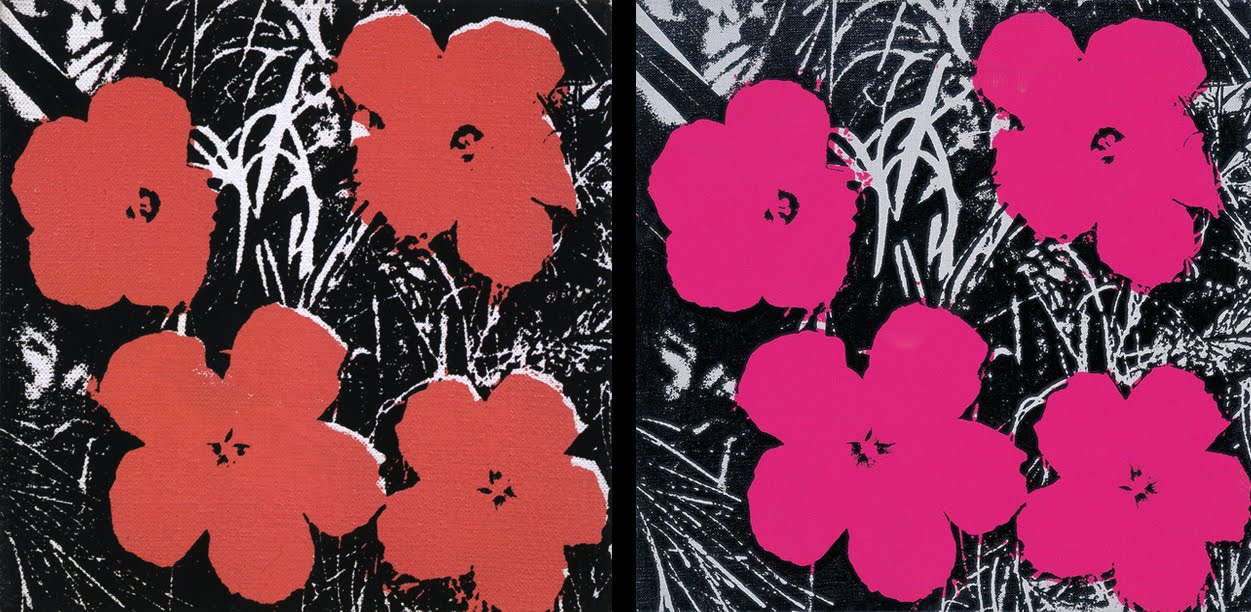
A while back, I wrote about how photography is the new painting. It was probably something you should read about here. Anyway, today, I was again reminded of how much our digital (and analog) devices warp the world around us while at my trusty gallery day job. I was looking for information about the work above to the right, the hot pink Warhol flowers. After doing a little research on the piece, I discovered it actually looked like the picture on the left, more of an orangey-coral than a fuchsia. When a work relies on one single specific color to differentiate itself from hundreds of other, it seems like good, true to life artwork photography would be a priority for those dealing with the piece. But good artwork photography is hard to get and digital images degrade over time (just like paintings) so distortion continues to be a problem.

I'm still backed up here at F***ART, and have yet to post about the May auctions or my recent viewing of the short film 16 Minutes with Ultra Violet, but stay tuned for more posts soon, I promise!

Also, a side note: what species are Warhol's "flowers"? He obviously chose the image as quintessentially floral, but no amount of googling seems to yeild me with an answer as to what this most-floral of flowers is. (The fact that it's a pretty blown-out image doesn't help my search either)

Tuesday, April 20, 2010

Baby, Hold on to Me

An interesting article in the New York Times today got me thinking about the rules of art auctions and how they can be a double-edged sword.

The article (which you can read HERE) talks about how collectors (in particular, Craig Robbins, pictured above) who resell artwork they've bought on the primary market (or directly from the artist's representative) on the secondary market (or resale galleries/auctions) can be blacklisted for doing so too soon or even at all.

What's interesting is the way that strict unwritten (or according to the Times, written) rules govern the way collectors are allowed to buy and sell artwork if they want to stay in with the in crowd. It's a terrible faux-pas to resell art too soon after purchasing; it makes the work seem like a financial gamble instead of a masterpiece. It's even less couth to resell a work of art within a few years of being at auction, because, particularly with the growth of sites like artnet.com, the auction record is available publicly and everyone knows on exactly what day the work sold for and for how much--down to the penny.

But the granddaddy of all scarlet letters for artwork is the "BI" (short for Bought-In, or not sold at auction). For the rest of the artwork's life, no matter how lovely and well-priced, the work will always struggle because of its unshakable mark of BI-ness. It doesn't matter why the work BI'ed--there could have been, say, a volcano, that blocked all flights to the auction, or maybe just no good buyers for a very good work with a fair value--people don't want art that has BI'ed

When you think about all the risks involved, it's easy to wonder, why the hell would anyone ever auction off anything? The flip-side of the auction coin is that it can be a great way to raise some quick cash and/or to deaccession works that you just don't have time to deal with. And the there's always the promise of a jackpot--the Picasso or the Doig or the Giacometti that suddenly sells for far beyond the high estimate not only making you rich, but also changing the whole game.

Friday, March 26, 2010

Shear Loveliness

Francois-Xavier Lalanne's sheep, both fluffy and stone, seem to keep popping up in my life and they are so stinking cute I can't handle it. They're apparently impossible to get your hands on, and it's just kind of funny that such a cute and silly decorative sculpture is so trendy. But I still have to sheepishly admit that I adore these little guys.

Tuesday, March 16, 2010

When You Point One Finger at MoMA, Three Point Back at You.

While reading this week's big article about performance art in the New York Times, I came across THIS:

"But often, performance at MoMA itself has consisted of unsanctioned protest actions against the museum. In 1969, for instance, the Guerilla Art Action Group removed Malevich’s “White on White” (1918) from the wall and replaced it with a manifesto. Also that year four members of that group stormed the lobby, held a wrestling match and fled, leaving behind a pool of animal blood and handbills demanding the resignation of all the Rockefellers from the museum board."

The next sentence from the article appears in parentheses, though it seems terribly important to me: "(Documentation from these events is now owned by MoMA and can be seen in the show “1969” at P.S.1 through April 5.)"

It's in those parentheses where we learn that MoMA acquired documentation of protests against the institution itself and now displays them. I'm not really sure what to make of this, and I wonder what the Guerilla Art Action Group thinks about it (especially since there are still several Rockefellers on the board). In addition, P.S.1 charges admission, so these protest documents have actually begun making the institution money.

I'm sure the Guerilla Art Action Group is pleased that their role in art history is being recognized by a major museum, but the idea still seems a little contradictory. Are MoMA's intentions simply to show art history as it happened or are there other forces at work? Maybe MoMA wants street cred for celebrating those who take aim at it, a la Sarah Palin and Saturday Night Live?

Thursday, February 4, 2010

I Got Giaco-money in the Bank.

So last night Alberto Giacometti’s Walking Man I broke the auction sales record, selling at Sotheby's in London for $104.3 Million. Estimated to sell at just $20-28 Million (oh a mere $20 mil?), everyone wants to know who the hell bought this thing for so much money? Seriously.

The previous record holder was Picasso's Boy with Pipe which sold for $104.1 Million in 2004. There are two things that really shock me about this record being broken by this piece:

1. It's one of an edition of 6 + 1 AP. So its not a unique object.
2. Picasso is, well, Picasso. He's so highly regarded by people in the arts and is a household name. Giacometti is certainly one of the last century's greats, but he doesn't carry the same clout as Picasso.

It's unbelievable to think someone could spend over $100 Mil on one object. I mean even if you are worth $1 billion, that's 10% of you net worth. And we're not even talking about $100 Mil of your net worth, this is an amount existing in cash, ready for spending.

As much as I love the arts, its this kind of spending that makes me so conflicted about this field. $100 Mil could do so many good things. And beyond that, earning that kind of money is inevitably done on the backs of cheap labor and exploitation. Not that I can't say that my entire doesn't life rests on exploitation; the clothes I'm wearing, the computer I'm typing on, the table the computer sits on...I know people died for them. This is another topic for another time, but the whole idea that there are people worth more than the GDP of Zimbabwe who spend like this is so complicated and morally ambiguous for me. How can we reward hard work without rewarding exploitation? Is it really impossible?

Friday, January 29, 2010

Betting the F***ART

I ususally think of museum big-wigs as being humorless, pretentious, and tightly-wound (sorry, ya'll, that's just been my experience.) However, the directors at the Indianapolis Museum of Art and the New Orleans Museum of Art are upending my stereotyping by making wagers on the superbowl--winner gets a work from the other museum on loan for three months! There's been one-upping, trash-talking, and a deal has finally been reached. Guess the Art Capital Group isn't the only organization making bets with artwork these days...

Tuesday, January 26, 2010

Don't Fear the Reaper, Fear Adult Education Classes

So people are all worked into a frenzy about this old lady who ripped a Picasso at the Met. There are two burning issues in my mind right now on this topic:

1. What was this woman doing/wearing to literally rip a huge hole in a painting? I'm imagining her wearing some goth outfit covered in spikes (see above) or having some crazy big Flo-Jo nails. Maybe granny's got a little shiv in her pocket to keep herself safe on the mean streets of the Upper East Side?

2. Knowing that this painting will be painstakingly repaired by the best restorers in the world, it's interesting that people are still so worried about this. Anyone who's seen a patched hole in a canvas knows that when done well, no one can tell. I anticipate that the painting will look exactly the same as it did two days ago (just as casino magnate Stephen Wynn's Picasso does post-patch). Certainly it's worth noting that the work is on a delicate old piece of fabric that must be handled with care and that could suffer further damage from being moved and handled during restoration. What I'm trying to say is this: since the painting is going to be visually the same, are people afraid of the monetary loss or does thinking about the fact that even timeless objects decay and get damaged make us fear death? I've always kind of wondered if the whole idea of restoration is largely about our fear of death; if stopping the decay on an object lets us feel like we're evading the reaper.

Monday, January 25, 2010

The Deaccessioning Debate Rages on

As more and more museum personnel see themselves getting laid off, the AAMD (Association of Art Museum Directors) continues to view deaccessioning (selling off artwork to pay the bills) as the cardinal sin of museum management. They argue that selling off works to pay the bills encourages poor management and bad use of funds, but in this economy does that argument still hold water?

My new FAVORITE blog, The Art Law Blog, talks about this controversy: http://theartlawblog.blogspot.com/2010/01/more-on-fresno-museum-closing.html.

Friday, January 15, 2010

Sol LeWitt or Moderately Priced Furniture?

This category of comparison is proving to be one of endless possibilities.

Wednesday, November 4, 2009

The dark cloud hanging over auction season...


The auction itself was pretty dull all in all (read more about that here:http://www.nytimes.com/2009/11/04/arts/design/04auction.html?ref=arts), but the dullest thing there were the catalogue photos of the work! I understand we're all feeling the little grey recession-cloud hanging over the auctions this year, but does that cloud need to be apparent in the photos of the work? I guess Christie's really IS cutting catalogue expenses by hiring a blind five year-old to shoot the work. Sheesh.

I've shot my own work before. I've shot work at the gallery's I've worked in. I'll admit, it's not always easy, particularly when you're dealing with glass, weird lighting situations, shiny oil paint, etc. But with a tripod and Photoshop, any moderately schooled fool can get this stuff close to right!


Thursday, October 22, 2009

Jeff Koons or shitty Christmas gift?

My boyfriend likes to tell a story about the worst Christmas gift he ever got: a Chia Pet. All I can tell him is just to be glad he didn't get a Jeff Koons instead.

Wednesday, October 21, 2009

Blood Diamonds: "Damien Hirst Trips Over a Diamond the Size of his Head and Dies"

Here are some things I’d rather do than continue to think about Damien Hirst this week: 

1. Watch more Bloomberg campaign ads

2. Clean my cats’ litter box

3. Look at Ryan Seacrest’s shit-eating face

4. Try to get my health insurance company to provide me with basic services

5. Become friends with the idiot I’m watching get screamed at by Judge Judy

However, when I came across this jewel (pun intended), I just had to continue to expend energy worrying about Mr. Hirst’s rich ass.  The image above is an edition of work by a duo of Dutch artists known as PIEK! and is entitled “Damien Hirst Trips Over a Diamond of his Head and Dies.”  Wouldn't we all love for the only casualty of Hirst's gratuitous use of blood diamonds to have been himself?  

Luck for you, there are still a few available! see more here: http://www.piek.com/ned/werk/damien/index.html

Also check out there series of self portraits (photos taken by people selling mirrors on craigslist. genius).

John McCracken or Cheap Furniture?

In honor of some of our most recent posts (Damien Hirst or Halloween decor, and the "Donald Judd or Cheap Furniture" quiz) I bring you "John McCracken or Cheap Furniture."

Want that mirror? Check it out at cb2: http://www.cb2.com/family.aspx?c=589&f=4407

Monday, October 19, 2009

So Cute... I'm Getting All Faklempt

I am going to try and keep it under control here, but holy monkeys, I love cute things. I don't think I am alone here. Japan has Kawaii, which is cuteness embraced at the national level, and New York has these simply amazing lottery advertisements. If you haven't seen these commercials, you really should look them up. There are bunnies in people clothes doing people things in miniature environments. I just can't handle all the fluff!

So I figure that it is time to give a shout out to cute art. First of all, it is so smart from a commercial standpoint (kinda important if you want to make rent each month). Cute stuff sells. You can have a cute painting up in your house and not worry what your Great Auntie Mable is going to say when she comes over to visit; don't lie, you know that you have one piece in your collection that is too much of a conversation starter for family viewing. And then cute things are just plain fun. They tap into a childlike mental state we all have where you can just like something without having an intellectual or conceptual justification for it.

Let's take a look at Florentijn Hofman, Dutch artist whose globe trotting, ginormous duckie is pictured above, Rubber Duck In Osaka, 2009. Hofman's work varies in theme (always whimsical but not always cute animals) however, everything is always done on a large scale. I think this is a great strategy to keep things from getting too cloying and also giving just enough of an innovative edge. Still, large works means lots of money--not something an unestablished artist can easily attempt. So let's try at cute on a smaller scale...

Check out Inhae, an artist from Berkley who is now the notorious chronicler of My Milk Toof. The story line goes like this: you loose your baby teeth/milk teeth when you are a kid and they wander off to who knows where (I unfortunately do know; my mom has them in a jar next to old house keys...shudder), then one day Inhae's teeth show up with faces and personality, and now they all live together and Inhae records their misadventures on her blog My Milk Toof. These 'teeth' are made of polymer clay and are essentially props for some rather adorable photography. The artistic innovation here is using the Internet as a gallery and the blog becomes the actual art piece.

But what if you prefer a hermit, bunker style studio with no Internet access? We have you covered!! Amigurumi is the Japanese art of making cute, crocheted, stuffed figurines with anthropomorphic features. Here in the US I guess this is more of an Indie craft thing, but in Japan it is a full on art form. I think Amigurumi is one of those things that could be just a fun decoration, but it has the potential to be flushed out into an interesting installation or creepy/adorable public art project.

Or you could just train cats to dance with each other while wearing bloomers and top hats.

Go and hassle the Hofman: http://www.florentijnhofman.nl/dev/index.php
See Toof on Toof action: http://mymilktoof.blogspot.com
Your daily fiber art: http://www.fullamigurumi.com/en/

Sunday, October 18, 2009

All that glitters is not worth $100 MIL...

Piggybacking off Allie's last post, I thought I'd give ya'll a side-by-side skull comparison. At left is Damien Hirst's "For the love of God, 2007"  valued at $100,000,000; at right is one of Pottery Barn's newest Halloween acessories "Glitter Skull" valued at $19.  Remind you of one of these shitty fashion magazine features entitled "Blow the rent, Pay the rent?"

Friday, October 16, 2009

OOOOO, Sparkles!!

I am not sure if I am a fan of Damien Hirst. Yes, I like most of his ideas, but I am so professionally offended by his art factory and general whoring it up that I have a hard time really appreciating his concepts. For the Love of God was no exception. I can really get behind the inspiration, which was reportedly his mother asking him something along the lines of, "well... what are you going to do now?" Of course, cover a skull with diamonds. Personally, I would have trained hamsters to perform The Rite of Spring but with a post apocalyptic twist (after three martinis, you would totally pay to see this).

The funny thing about this skull is that the idea has to be the artistic genius in this piece as Hirst in no way did this himself. Not that I would necessarily fault him for this as he is not a jeweler, however it is the flawless execution which is the real selling point of this piece. Seriously, if it wasn't flawless it wouldn't be creepy or nearly so emotive. Hearken back to the scandal with Spiritus Callidus #2 by John LeKay; the Pillsbury-esque crystal skulls which is the idea that Hirst allegedly ripped off. The reason why no one really bought into the concept stealing (no matter how likely it was the Hirst did take the idea) was that a professional jeweler doing an amazing job of faceting the skull took the concept to an original place. Bearing this controversy in mind, Hirst can in no way take credit or copyright of this sparkly skull idea otherwise he opens a can of worms all over himself. Well, this is where irony steps in. You can now own your own 'diamond encrusted skull' from Pottery Barn. I heart you karma.

Hey kid... You wanna buy a skull?: http://www.potterybarn.com/products/glitter-skull/?pkey=call-decorative-accents

Do you think it is a rip off?: http://en.wikipedia.org/wiki/John_LeKay

Wednesday, September 16, 2009

WalmART

Oh goody, it's another quiz!!It is fairly easy to spot which is art and which is Walmart furniture, but I am entertained with the humor. It is pretty amazing how Modernism is what contemporary furniture looks like. I wonder what mainstream will look like in another 50 years. Personally, I am getting tired of all the clean lines and the photoshoped, graphic aesthetic. Maybe it is because a 10 year old with a paint program could make most of those designs and a 10 year old did make that cheap, Modernist furniture. Not that there is anything wrong with children getting immersed in the arts at a young age. I guess that we all owe Walmart thanks for making art accessible to everyone, regardless of age and socioeconomic status. http://reverent.org/donald_judd_or_cheap_furniture.html

Sunday, July 12, 2009

So Sue Me: The Art of the Copyright

Everyone knows that copyright is a big deal, especially in art, where we are banking on the ownership of our creations in order to extract all possible value and buy groceries. And let's be honest, having someone steal your images and pass them off as their own is like winning the lottery. Not only would you be able to prosecute and make some money, but if you spin it right, you could generate some more cash off the publicity. On the other hand, if you change something substantially, it should be yours home free and is even covered Constitutionally as free speech (just be prepared to fess up to the fact that you used something/someone else as a starting point).

Warhol's Campbell's Soup Cans is a great illustration of this perspective. Obviously he was banking on the iconic nature of an object and it's originator while modifying the 'can' enough that it is an entirely unique and original item. I don't think this could have been made today without a pretty big law suit going down. There are many instances of appropriation with owned images and icons, but the minuet that the piece gets some monetary attention, the lawyers are called out (I am now thinking of a Mr. Burns type, "release the hounds"). A sad truth that does not seem to stop many artists in their 'borrowed' creations. Besides, that 'illegal' factor adds some mystique to the whole 'art' thing and can serve as the conceptual justification for some people in their art making. Personally, I do enjoy a bit of smart-ass and liability in art periodically.

For a chuckle: http://www.illegal-art.org/print/index.html.

Saturday, July 11, 2009

Christie's Art Handler's Farewell Email. A True Classic.

One of my all-time favorite virals from one of my all-time favorite websites--passiveaggressivenotes.com.

Enjoy!